
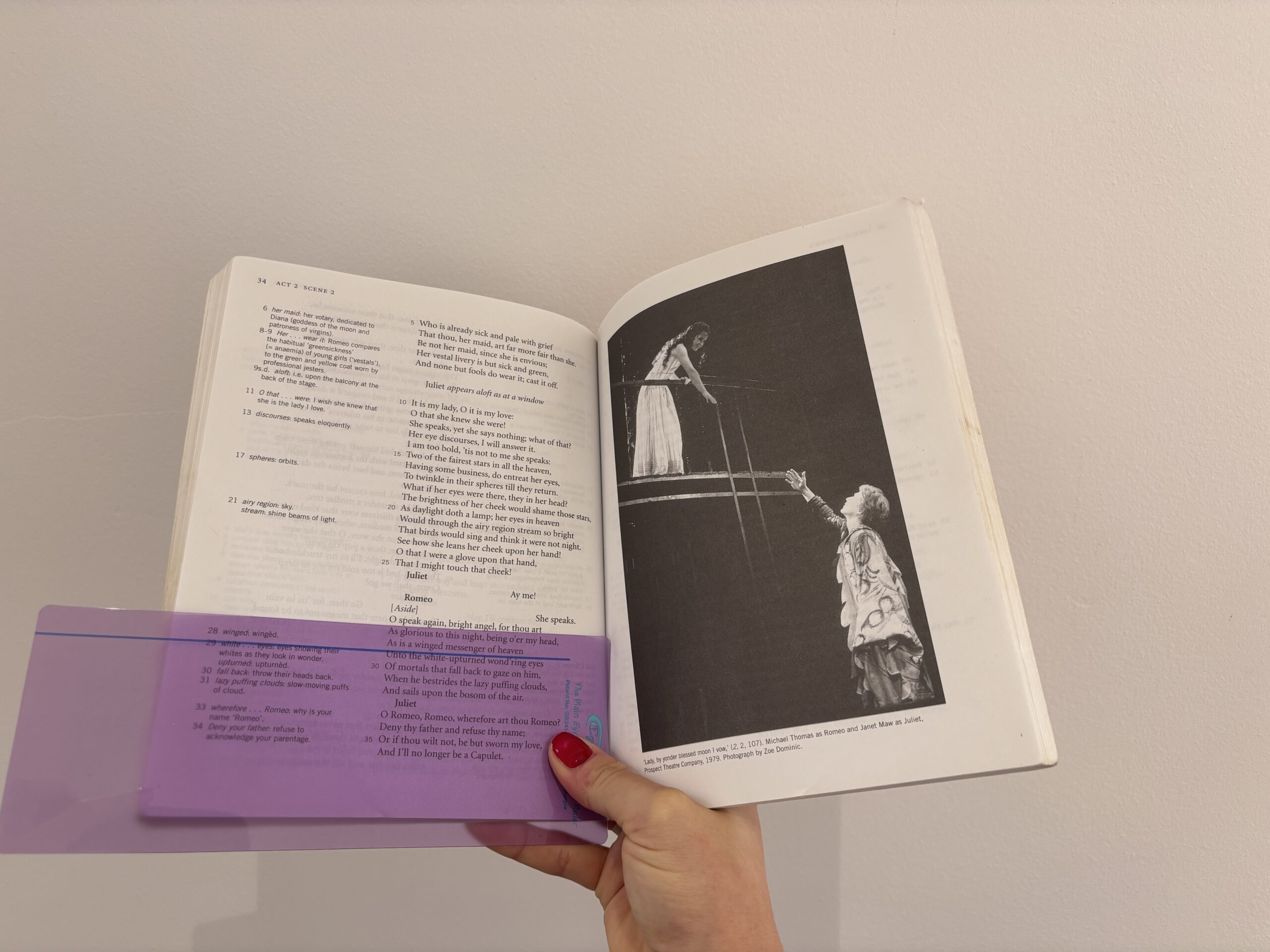
One of the difficulties in the modern classroom is the issue of split attention. The brain learns what it attends to, so securing the attention of all learners in the classroom is a very important starting point for teaching and learning. Reading is the bedrock for accessing the school curriculum and it is a multi faceted skill. Why we read differs from subject to subject; are we searching for hidden meaning and depth, are we hunting for facts, are we trying to find links between different factors or events? This is just the starting point. In the primary phase the main focus for reading is on developing fluency via phonics and then comprehension of text. As learners move to the secondary phase other academic approaches to reading become more important in their learning.
There is a body of evidence suggesting reading rulers (which are also coloured overlays) are beneficial for supporting attention and reading focus in secondary school. They are particularly useful for students with attention deficit, ADHD for example, dyslexia or visual processing disorders but can help all students to focus on a particular part of the text as directed by their teacher. If we allow fluent readers to skim read academic text without focusing on the core purpose and type of reading skill they need to employ, then aspects of their learning will be less effective than if they followed the text, as the teacher modelled the discrete reading skill needed for that academic subject and that particular task. Similarly, if we allow fluent readers to read ahead during our daily reading tutorials there is a danger that they skip over words they don’t know, their fluency means they can decode and read the word with ease, but they do not fully comprehend the meaning of the word. The teacher leading the reading session can not respond to a class of students who are all at different parts of the text. One of our key aims via the reading tutorial, is to expose our students to a wide range of new vocabulary. This requires a teacher led approach to reading which reading rulers help us to facilitate.
Reading rulers are a form of visual tracking aid and can also help to reduce cognitive load, helping students to build reading stamina and to sustain attention during learning tasks. Coloured overlays like reading rulers have been shown to increase reading speed and accuracy, particularly for students with attention difficulties or dyslexia. However, students with these barriers to reading can feel singled out if they are the only ones using a reading ruler. A core theory around maintaining a truly inclusive environment is that barriers are not caused by individual impairment, but how school (and other institutions) are structured. We give every student a reading ruler when they join our school, not just those with SEND or a learning need. Another reason therefore, that we ask all students to use a reading ruler, is to maintain an inclusive learning environment. By asking all students to use a reading ruler we ensure that it becomes the ‘norm’ and no one feels different by using one. Inclusive education is not about helping SEND students with different practices, it is about redesigning our approach so that no one is disadvantaged in the first place.
If you would like to delve into the evidence behind this blog please use these articles as a starting point:
Wilkins, A., Lewis, E., Smith, F., Rowland, E., & Tait, A. (2001). Coloured overlays and their benefit for reading. Journal of Research in Reading, 24(1), 41–64.
Taylor, S. (2011). An investigation into the effectiveness of coloured overlays in improving reading ability. Educational Psychology in Practice, 27(4), 365–377.
Uccula, A., Enna, M., & Mulatti, C. (2014). Colors, colored overlays, and reading skills. Frontiers in Psychology, 5, 833. https://doi.org/10.3389/fpsyg.2014.00833
Millard, B., & Lynn, A. (2005). Helping students read: The effectiveness of visual supports. Support for Learning, 20(2), 70–75.